

What Is a Martech Stack – And Why Yours Is Probably Wasting Budget
Your marketing team is running 20, 30, maybe 40+ tools. Yet campaigns still feel slow, attribution is murky, and leadership keeps asking where the budget went. The problem usually isn’t a missing tool – it’s the martech stack you already have.
What Is a Martech Stack?
A martech stack (short for marketing technology stack) is the collection of software tools and platforms a marketing team uses to plan, execute, measure, and optimize their campaigns. It typically includes a CRM, marketing automation, analytics, attribution, paid media, personalization, and increasingly AI tools.
In 2025, researchers catalogued over 15,000 commercial martech solutions globally. The average enterprise runs between 20 to 45+ tools in its martech stack at any given time. That sounds like a competitive advantage. In practice, for most organizations, it’s a budget leak.
The State of the Martech Stack in 2026
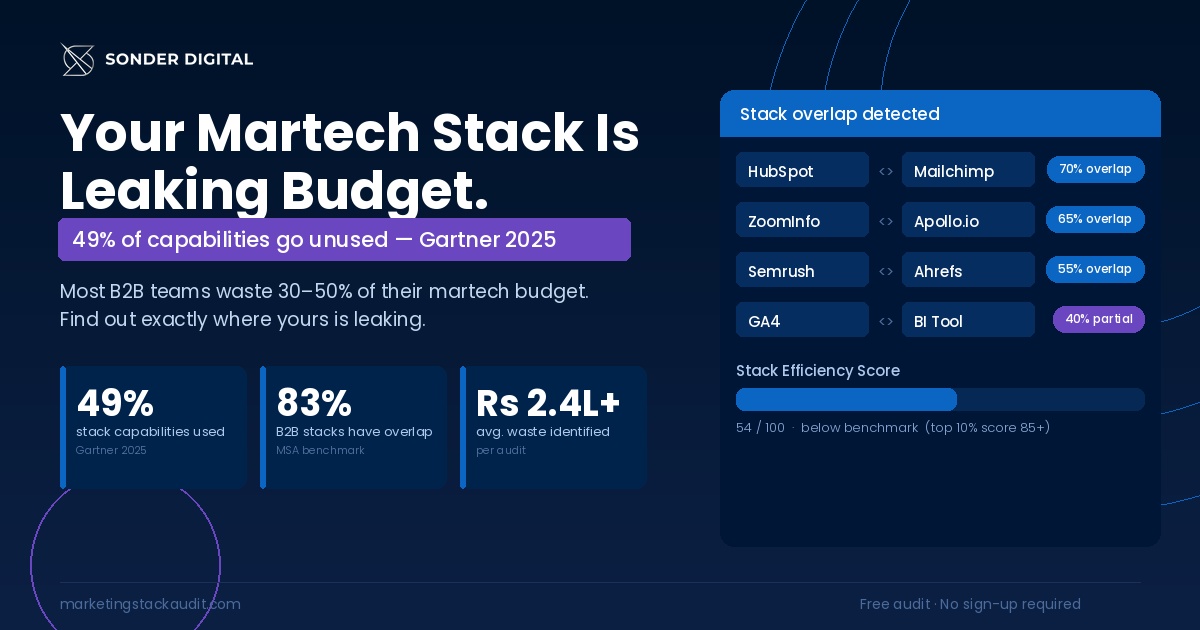
According to Gartner’s 2025 Marketing Technology Survey, marketers are using only 49% of their martech stack’s capabilities — and that’s actually an improvement. In 2023, that figure was just 33%, down from 58% in 2020. Utilization has been falling steadily, even as martech spending climbed 35% between 2020 and 2023.
The financial implications are not abstract:
- A company generating $250M in revenue could waste close to $4 million annually from martech underutilization alone (Gartner)
- Unused SaaS licenses cost companies an average of $21 million per year – source: Zylo 2025 SaaS Management Index
And yet — the tools keep getting added.
Why Martech Stacks Get Out of Control
It doesn’t start with recklessness. It starts with reasonable decisions made in isolation. A campaign needs better tracking, a new tool gets added. Sales wants more visibility, another tool follows. Someone reads about AI and three more enter the stack.
Here’s why this pattern keeps repeating:
1. Nobody Owns the Full Martech Stack
Marketing buys tools. Finance approves budgets. IT integrates systems. Agencies layer on their own platforms. But no single person or team owns the martech stack as an interconnected system. Gartner research shows that marketing covers only 50% of enterprise martech spend, with IT covering 34% and other departments picking up the rest. When three departments are paying for technology without a unified view, waste is structural — not accidental.
2. Finance Tracks Cost, Not Utilization
Budget approvals are typically based on vendor proposals and business cases. They’re rarely tied to feature adoption rates, actual usage metrics, or ROI contribution. That’s how underused tools get renewed year after year — no one is asking the right question.
3. Teams Build Silos, Not Systems
SDR teams adopt outreach tools. Content teams adopt AI tools. Performance teams adopt analytics platforms. Each decision is defensible on its own. Collectively, they create a fragmented martech stack with duplicate capabilities, disconnected data, and no clear attribution path.
“The challenge is no longer access to tools. It’s managing complexity.” — Scott Brinker, ChiefMartec
What Martech Stack Waste Actually Looks Like
You’ve likely seen these patterns in your own organization:
The ‘We Already Have That’ Moment
Someone proposes a new tool for email workflows or lead scoring. Someone else says, “Don’t we already have that in our CRM?” The room goes quiet. Because yes — you do. You’re just not using it.
The Enterprise License, Basic Usage Problem
You’re paying for a powerful platform — but your team uses it only for sending emails and pulling basic reports. The advanced features sit dormant. According to Gartner, organizations consistently use only about one-third to half of what their premium tools actually offer.
The ‘Too Many Dashboards, No Answers’ Problem
You have Google Analytics, CRM dashboards, ad platform data, and a BI tool. When leadership asks what actually drove revenue last quarter, the answer is still unclear. More tools do not automatically produce better visibility. Data integration remains the number one management challenge for mid-market and enterprise teams.
The Overlapping Tool Problem
Gartner found that 30% of marketers attribute martech underutilization specifically to overlapping capabilities across tools. You’re paying twice for the same function — and using neither version well.
The Real Cost of a Bloated Martech Stack
Budget waste is the obvious concern. But the operational costs run deeper:
- Slower campaign execution as teams navigate too many tools
- Manual reporting overhead from disconnected platforms
- Broken attribution models from fragmented data pipelines
- Poor decision-making driven by conflicting metrics
- 67% of survey respondents said low martech utilization undermined their department’s organizational credibility (Gartner)
- 69% reported that underutilization negatively affected their following year’s budget (Gartner)
The compounding effect matters: low utilization → reduced ROI evidence → budget pressure → fewer resources to train teams → even lower utilization.
What a Martech Stack Audit Actually Finds
A structured martech stack audit is a strategic lever, not just a cleanup exercise. When organizations go through a rigorous audit, they typically uncover:
- 20–40% tool redundancy — multiple tools performing the same function
- Significant underutilization of premium platforms — paying enterprise pricing for basic use cases
- Critical integration gaps — tools that don’t talk to each other, creating data silos
- Misalignment between tools and funnel stages — investment concentrated in the wrong areas
A thorough martech stack audit covers five areas:
- Tool inventory — a complete list of every platform across marketing, sales, IT, and agencies
- Usage mapping — who uses what, and how often
- Capability overlap analysis — identifying where multiple tools serve the same function
- Integration audit — assessing data flow between platforms
- ROI alignment — connecting tool investment to measurable business outcomes
How to Optimize Your Martech Stack: What High-Performing Teams Do Differently
Gartner’s 2025 data shows that only 15% of organizations qualify as high performers — meaning they meet their strategic martech goals and demonstrate positive ROI. What separates them?
They Measure Usage, Not Just Cost
High-performing teams track feature adoption, active user rates, and capability utilization — not just license fees. Usage data drives renewal decisions.
They Tie Tools to Business Outcomes
Each platform in the stack is mapped to a specific stage in the funnel and a measurable outcome. Tools without clear attribution to the pipeline or revenue get scrutinized.
They Build Composable, Modular Architectures
Rather than accumulating point solutions, leading teams design their martech stack around a clear data spine — typically a CDP or CRM — and connect execution tools to that core. This reduces integration complexity and improves AI accuracy.
They Eliminate Redundancy Aggressively
The question isn’t “do we have a use case for this tool?” It’s “do we need a separate tool for this, or can existing platforms cover it?”
They Invest in People, Not Just Platforms
The 10/90 rule — originally from Avinash Kaushik and widely cited by Scott Brinker of ChiefMartec — remains highly relevant: invest 10% in tools, 90% in the people who use them. Training, documentation, and internal champions are the most underutilized remedy for underutilization.
From One-Time Audit to Continuous Martech Stack Optimization
Traditionally, auditing a martech stack meant spreadsheets, internal interviews, and time-intensive reviews. The output was an outdated snapshot within months.
High-performing organizations are moving toward continuous visibility — tech-enabled platforms that map the full martech stack in real time, flag underused tools, surface cost leaks, and recommend consolidation before the next renewal cycle.
This shifts the martech audit from a one-time cleanup to ongoing strategic management. The goal is not a smaller stack for its own sake. The goal is a more effective stack — one where every tool earns its place, integrates cleanly, and contributes to outcomes you can measure.
The Honest Question Worth Asking Now
If you paused everything today and reviewed your martech stack:
- How many tools would you keep without hesitation?
- How many are genuinely used by more than one team?
- How many duplicate capabilities you already have elsewhere?
- How much budget could you recover or redeploy in the next 12 months?
Most organizations don’t need another AI tool, another analytics platform, or another automation layer. They need clarity on what they already have — and a plan to actually use it.
Most martech stacks have 10 tools. 4 get used. Find out which ones are costing you.
Free, 2 minutes. marketingstackaudit.com
Free Martech Audit Tool
Most martech stacks have 10 tools.
Only 4 are actually working.
Find out which tools are eating your budget, which ones overlap, and what to cut — in 2 minutes, no sign-up needed.
Identify unused tools
Spot budget leaks
Get a clear action plan
Active
Active
Duplicate
Unused